

Why Avoidance Feels Good (But Makes Anxiety Worse)
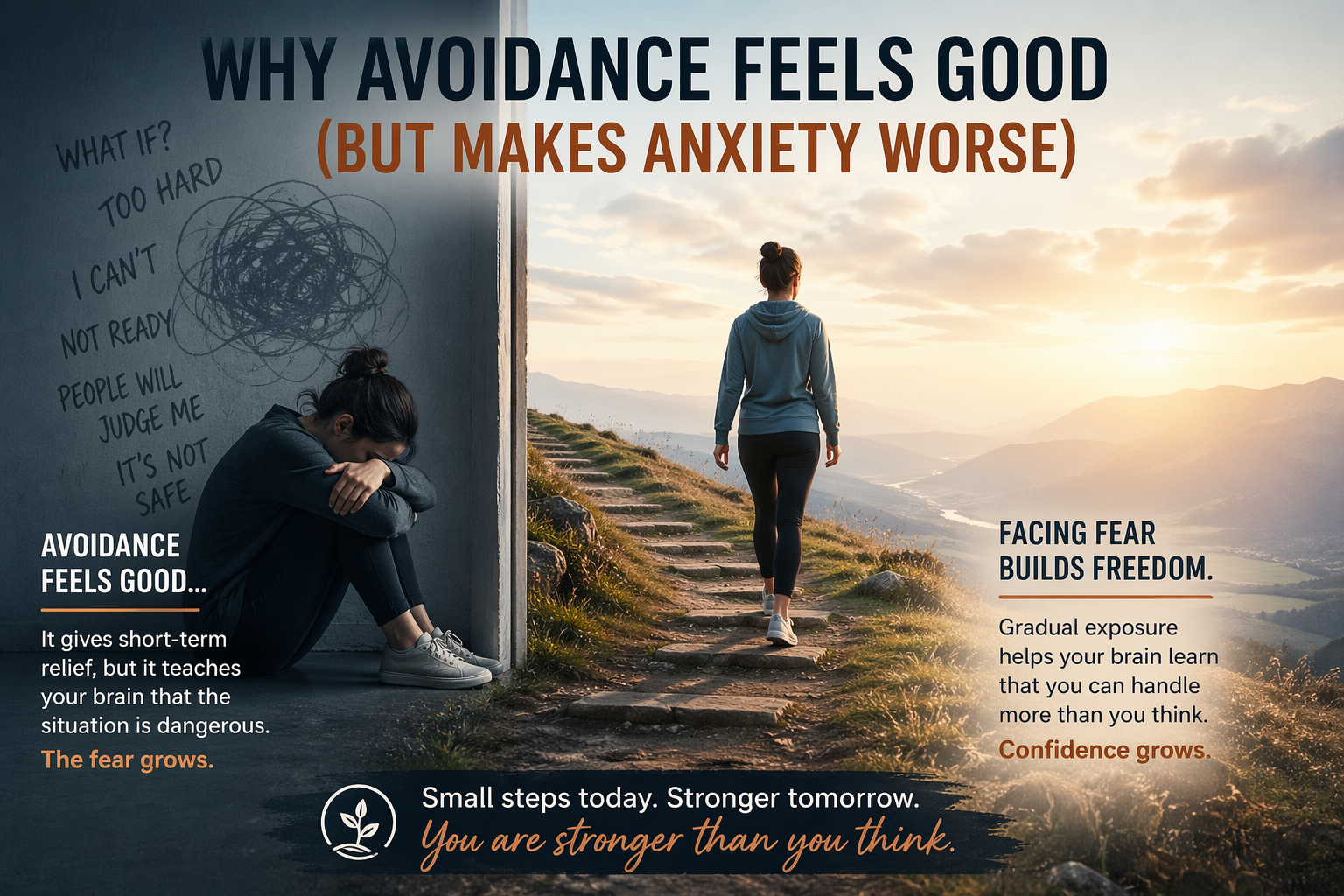
Avoidance is one of anxiety’s most convincing strategies—and one of the main reasons it tends to stick around longer than we’d like.
On the surface, avoidance feels like a solution. You feel anxious about something—a social gathering, a difficult conversation, a task you’ve been putting off—so you step away from it. Almost immediately, your anxiety drops. Your body relaxes, your mind quiets, and you feel a sense of relief.
That relief is real. But it’s also temporary, and it comes with a hidden cost.
Our brains are wired to remember what reduces discomfort. When avoiding something makes anxiety go away, even briefly, your brain takes note. It begins to associate avoidance with safety. Without realizing it, you start to rely on it more and more. What began as a one-time decision can quietly turn into a pattern.
The problem is that avoidance doesn’t actually resolve the fear—it protects it.
When you consistently avoid something that makes you anxious, you never give yourself the chance to learn that the situation might be manageable, or even safe. Instead, the unknown grows. Your mind fills in the gaps with worst-case scenarios, and over time, the fear can expand beyond the original situation.
Take social anxiety as an example. Skipping one event might not seem like a big deal. In fact, it may feel like a relief in the moment. But as that pattern continues, social situations can start to feel increasingly overwhelming. Confidence begins to shrink, and the belief that “I can’t handle this” becomes more deeply ingrained.
Avoidance sends a powerful message to your brain, even if you’re not aware of it: this is something to be feared.
The alternative isn’t to push yourself into the deep end or force sudden, overwhelming change. That approach can backfire and reinforce the same fears you’re trying to reduce. Instead, meaningful progress tends to come from a more measured, intentional approach.
Gradual exposure allows you to face what you’ve been avoiding in a way that feels manageable. It’s less about conquering fear in one bold move and more about building confidence through small, repeated experiences. Each time you stay in a situation just a little longer than you normally would, or take a step you might have previously avoided, you create an opportunity for your brain to learn something new.
Over time, those experiences begin to add up. Situations that once felt threatening start to feel more familiar. The intensity of the anxiety often decreases, not because you forced it away, but because your brain has updated its understanding of what’s actually happening.
This process is less about eliminating anxiety altogether and more about changing how you respond to it. Anxiety may still show up, but it no longer has the same level of control. Instead of dictating your choices, it becomes something you can move through.
A helpful shift can come from changing the question you ask yourself. Rather than focusing on how to get rid of the feeling, it can be more useful to consider what small step you can take, even while the feeling is present. That shift opens the door to action, which is where change begins.
Avoidance offers comfort in the moment, but it tends to narrow your world over time. Gradually facing what you fear, on the other hand, can expand it. With patience and consistency, those small steps can lead to a greater sense of confidence, flexibility, and control in your daily life.