

Why Relationships Sometimes Become Difficult—and How Better Communication Can Help
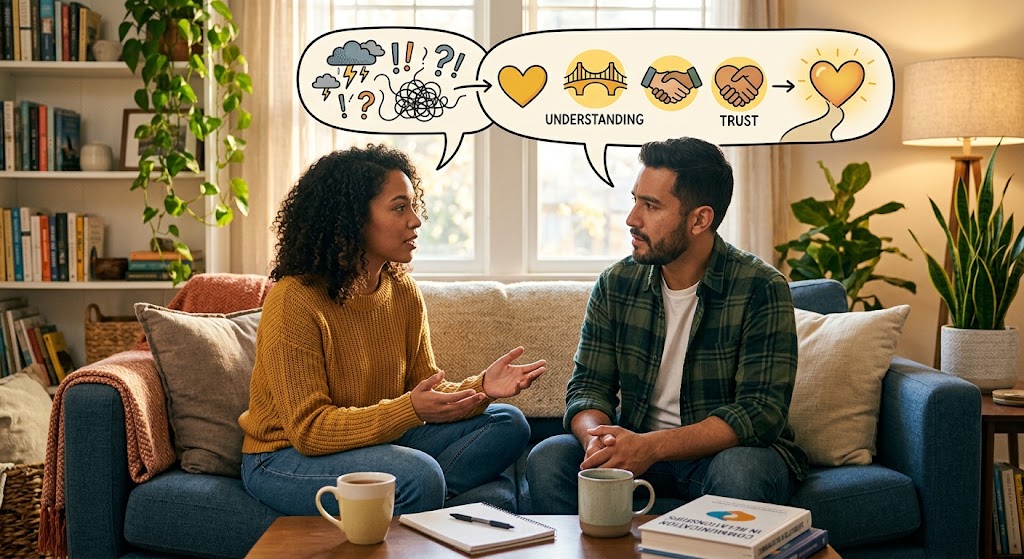
Every relationship experiences conflict.
Whether you’re dealing with a spouse, partner, family member, friend, or coworker, disagreements are a normal part of interacting with other people.
The problem isn’t necessarily conflict itself.
Often, the bigger issue is how we respond to conflict.
The Communication Cycle
A disagreement may begin with something relatively small.
One person feels ignored. The other feels criticized. Someone becomes defensive. The conversation escalates. Eventually, both people walk away feeling misunderstood.
Over time, the same pattern can repeat.
This can create a cycle in which each person reacts to the other rather than addressing the underlying issue.
Listening Is More Than Waiting to Respond
One of the most important communication skills is learning to listen to understand rather than listening simply to prepare your response.
That means trying to understand:
- What the other person is actually saying
- What they may be feeling
- What they need
- What concerns are underneath the disagreement
This doesn’t mean you have to agree with everything someone says.
Understanding and agreement are two different things.
Avoiding the “Always” and “Never” Trap
Statements such as:
“You never listen to me.”
“You always do this.”
can quickly make another person defensive.
Instead, focusing on specific behaviors and your own experience can create a more productive conversation.
For example:
“I felt frustrated when I was trying to explain something and the conversation changed before I finished.”
The goal isn’t to “win” the conversation.
The goal is to understand one another and find a way forward.
When Communication Has Broken Down
Sometimes couples or families have tried talking—and talking—and still find themselves having the same arguments.
That’s when having a neutral professional involved can be particularly helpful.
Counseling can provide a structured environment where people can slow down conversations, identify recurring patterns, and practice healthier communication.
Healthy relationships don’t require perfect communication.
They require a willingness to keep learning how to communicate better.